Posted in software online review

Chromium – Base

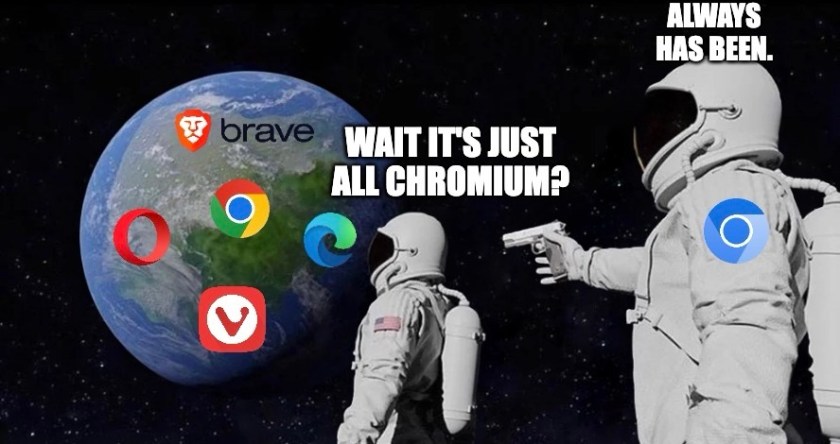
It’s true—Chromium has become the “engine” powering approximately 80% of the global browser market. While initiated by Google, it is an open-source project, allowing other companies to skip the massive cost of developing their own rendering engines and focus instead on unique features. StatCounter Global StatsStatCounter Global Stats +5

Browsers Built on Chromium:

Beyond Google Chrome, prominent examples include:

  • Microsoft Edge: Switched to Chromium in 2020 for better web compatibility and extension support.
  • Brave: Focuses on privacy by automatically blocking ads and trackers.
  • Opera & Opera GX: Some of the earliest adopters after abandoning their custom “Presto” engine.
  • Vivaldi: Aimed at power users with extreme interface customization.
  • Samsung Internet: The dominant browser for Samsung mobile devices.
  • Arc: A modern browser that rethinks tab management and user experience. Efficient AppEfficient App +6

The Major Exceptions (Non-Chromium):

Only two major players still maintain their own independent engines:

  1. Mozilla Firefox: Uses its own Gecko engine.
  2. Apple Safari: Uses the WebKit engine. Interestingly, Chromium originally started as a fork of WebKit before they split into separate projects. RedditReddit +3

Why the Shift to Chromium?

The transition is driven by securityspeed (specifically the V8 JavaScript engine), and a massive extension ecosystem. Maintaining a modern engine is so complex that even giants like Microsoft found it more efficient to adopt the Chromium base to ensure perfect website compatibility. Sahi ProSahi Pro +3

1. Privacy Differences (Brave vs. Vivaldi vs. Chrome)

While they are all built on Chromium, each browser handles your data differently:

  • Google Chrome: The least private. It integrates deep telemetry with your Google account and uses your browsing history for targeted advertising.
  • Brave: A “hardcore” approach to privacy. It blocks ads, trackers, and fingerprinting directly in the engine by default. It is also fully open-source.
  • Vivaldi: Focused on user control. It offers built-in blockers and granular permissions for every site. Unlike Brave, Vivaldi’s interface (UI) is not open-source, as noted in PCMag reviews.
  • Ungoogled Chromium: For maximalists—this is Chromium with every link to Google’s servers manually stripped out, though it requires manual updates.

2. The Monopoly Problem and Web Standards

Since Google controls Chromium’s development, it effectively sets the rules for the entire internet:

  • Dictating Standards: If Google introduces a new feature in Chromium (e.g., Privacy Sandbox), it overnight becomes the standard that web developers must follow. This makes it harder for Firefox (Gecko engine) to survive, as developers often optimize sites only for Chromium.
  • Manifest V3: Google recently changed how extensions work (Manifest V3), which complicates the effectiveness of traditional ad blockers. While Brave and Vivaldi strive to maintain old functionality, they are ultimately limited by what Google allows in the base code.
  • Antitrust Battles: Due to this dominance, the U.S. Department of Justice (DOJ) attempted to force Google to sell Chrome. However, according to rulings from September 2025, Google will not have to sell the browser but must share search data with competitors.

Conclusion: Which one to use?

If you want to escape Google’s influence, Firefox is the only true alternative with an independent engine. If you want Chromium’s speed but with privacy, Brave or the Mullvad Browser are the top choices for 2026.

https://www.chromium.org/getting-involved/download-chromium/

https://developer.apple.com/safari/resources/

https://chromium.woolyss.com/download/

https://download-chromium.appspot.com/

https://webkit.org/downloads

https://www.google.com/chrome/canary/

https://www.google.com/chrome/dev/

Posted in software online review

Roadmap and business roadmap

A roadmap is a strategic plan that defines a goal or desired outcome and includes the major steps or milestones needed to reach it. It also serves as a communication tool, a high-level document that helps articulate strategic thinking—the why—behind both the goal and the plan for getting there.

A business roadmap is a visual representation of your business strategy. It outlines the steps, goals, initiatives, and milestones needed to achieve your long-term plans. A business roadmap is also more tactical, focusing on how you will reach your objectives.

Eight Bukets – Challenge

Six – Create Value – Capture Value

I’m giving you the map, now you must walk the path

https://youtu.be/qllWAheHkms?si=fCkbOSRuRO5kZ0ol

The 80 – 20 Rule

https://www.investopedia.com/terms/1/80-20-rule.asp

Posted in software online review

Chromium

https://en.wikipedia.org/wiki/Chromium_(web_browser)

The One Investment Rule

https://youtu.be/IBD_AdM3WNI?si=xORYvpzXfwyYxO-a

Chromium org

https://www.chromium.org/chromium-projects/

browsing history

https://interestingengineering.com/culture/chatgpt-to-absorb-users-life-history

ghat gpt – gemini – missing personality

https://www.tomsguide.com/ai/i-switched-from-chatgpt-to-gemini-for-one-week-and-heres-why-im-going-back-to-chatgpt

Chromium base

https://www.pcmag.com/comparisons/chatgpt-vs-gemini-which-ai-chatbot-is-actually-smarter

Gemini

https://gemini.google.com/app/download

https://gemini.google/subscriptions/

Chat Gpt – Open AI

https://chatgpt.com/

https://openai.com/

https://en.wikipedia.org/wiki/OpenAI

Posted in software online review

Microsoft

https://visualstudio.microsoft.com/

https://about.ads.microsoft.com/en-us/partners/

https://www.microsoft.com/en-us/evalcenter/evaluate-windows-11-enterprise

https://www.microsoft.com/en-us/evalcenter/evaluate-windows-10-enterprise

https://azuremarketplace.microsoft.com/en-us/

https://azuremarketplace.microsoft.com/en-us/marketplace/apps

https://azuremarketplace.microsoft.com/en-us/sell

https://partner.microsoft.com/en-us/membership

https://partner.microsoft.com/en-us/training

Posted in software online review

software-online-review

NEED CONSTRUCTION WORKER – https://software-online-review.com/startup-online-hiring-scheme-online/ARCHITECTS & SOFTWARE DEVELOPERS

https://www.delawareinc.com/

https://eqvista.com/

https://www.ycombinator.com/library/Ek-stages-of-startups

https://www.investopedia.com/articles/personal-finance/011216/llc-vs-incorporation-inc-which-should-i-choose.asp

https://www.investopedia.com/terms/i/incorporate.asp

https://www.investopedia.com/terms/a/acquisition.asp

https://system1.com/

https://www.semrush.com/

https://www.theverge.com/2019/12/4/20994361/google-alphabet-larry-page-sergey-brin-sundar-pichai-co-founders-ceo-timeline

https://www.britannica.com/topic/Google-Inc

https://www.cnbc.com/2018/09/04/8-surprising-facts-you-might-not-know-about-googles-early-days.html

https://en.wikipedia.org/wiki/PageRank

https://www.google.com/search/howsearchworks/

https://www.google.com/search/howsearchworks/our-approach/ads-on-search/

https://developers.google.com/search

https://pagespeed.web.dev/

https://www.catchpoint.com/

https://search.google.com/search-console/about

https://sitekit.withgoogle.com/

https://www.investopedia.com/articles/markets/011516/top-5-google-shareholders-goog.asp

https://www.nasdaq.com/market-activity/stocks/goog

https://startup.google.com/programs/accelerator/

https://developers.google.com/community/accelerators

https://www.jetbrains.com/idea/

https://www.jetbrains.com

https://neuechair.com/

https://www.google.com/

The 5 stages of a startup

  • Solving the problem. Running a successful business is all about producing something that solves a problem. …
  • 2. Development. This is where it starts getting serious. …
  • Entering the market. …
  • Scaling. …
  • Maturity.

Buy it Now

https://sedo.com/us/

https://sedo.com/search/?keyword=software-online-review.com

https://www.trustpilot.com/review/software-online-review.com

Uncut Diamond

This article breaks down everything you need to know about uncut diamonds and how you can make a smart investment.

Filling in some gaps in your jewellery knowledge or trying to discover some untold secrets in the jewellery business? Uncut diamonds are not something that are often talked about. This article breaks down everything you need to know about uncut diamonds and how you can make a smart investment when picking out gorgeous stone jewellery.

Uncut Diamond Jewellery explained?

An uncut diamond, as suggested by the name, is a diamond in its most natural form. Prior to any shaping to enhance proportion, symmetry and polish involved in diamond cutting, an uncut diamond is a raw diamond that is completely virgin and free from human manipulation.

What is an uncut Diamond worth and why are Diamonds cut?

Apart from their quirky edge, there is not a whole lot of value in purchasing raw diamonds. Uncut diamonds are typically worth less than traditionally cut diamonds as their unpolished, rough edges hinder how well light is refracted. This reduces their sparkle and brilliance, thus reducing their market value. 

What does a raw uncut Diamond look like?

An uncut diamond is often bumpy and dull with no real structure. An acquired taste, uncut diamond rings provide a uniqueness and level of beauty some like to hold with others even looking for a rough diamond ring to mark their love.

Diamond Cut Breakdown

To create beautiful diamonds that are worth thousands, diamond cutters have the difficult job of trying to create finished products which align in proportion, symmetry and polish. Make no mistake, while this is easy to decide in theory, cutting diamonds is  a challenge where compromises often have to be made. Compromising factors such as diamond weight, to create the right proportions and symmetry, or  proportions and symmetry to avoid cutting further diamond and reducing weight.

In a similar way to natural diamonds, poorly cut diamonds can also refract light badly, resulting in little to no sparkle and less spread for your carat weight. To identify how you can be savvy and well informed when choosing your own diamond jewellery, here is everything you need to know about cuts. 

Developed in the 1940’s to 1950’s by the Gemological Institute of America (GIA), cut grades were developed to allow independent labs to identify a diamond’s clarity, colour and structure. A prime example of a predetermined cut grade is a brilliant cut diamond which will have 57 or 58 facets accurately cut and defined. While miniature, this provides a system to govern how well a diamond will sparkle.

While they offer a significant discount in price, poorly cut diamonds lack luster and you will be paying for a diamond without any sparkle. To ensure that you have an effective diamond that is worthwhile, we always suggest purchasing a diamond with an “excellent” to “good” cut. However, if you are still interested in purchasing a diamond of a lower cut, we suggest taking a look in person under various lighting conditions to avoid any disappointment.

Website, other related websites and blogs created as a scratch base pilot project for merging and evolving to something better and highly valuable.